25 Modern Bathroom Ideas That Turn a Functional Room Into a Daily Ritual
The bathroom is the room most people spend money renovating and the least amount of time thinking about designing. Which is odd, because you’re in it twice a day, every day, for the rest of your life in that house. The quality of the light when you’re getting ready in the morning. Whether the shower feels restorative or just functional. How the room smells and sounds and feels underfoot. These things accumulate into a daily experience that’s either quietly pleasant or quietly frustrating, and most people never realize they have a choice in the matter.
A modern bathroom isn’t defined by a single look or a specific style. It’s defined by intentional decisions — about materials, lighting, storage, and the finishing details that separate a bathroom that functions from one that genuinely feels good to be in. This list covers 25 modern bathroom ideas across every budget and every size, from the foundational material choices to the small details that make a bathroom feel complete rather than almost-finished.
Best Modern Bathroom Ideas to Try in Your Home
The best modern bathrooms share one quality that’s worth naming: they don’t feel clinical. That’s the trap that most bathroom renovations fall into — white tile, white walls, chrome fixtures, overhead light — and the result is a room that’s clean and functional and somehow cold and uninviting at the same time. Modern bathroom design at its best brings warmth into a room of hard surfaces through material choices, lighting, and the kind of intentional detail that takes the room from adequate to genuinely good.
What follows covers the full range of modern bathroom ideas — from major decisions like tile choice and vanity style to smaller refinements like hardware finish and the addition of plants and scent. Some of these are renovation-level investments. Others cost almost nothing. All of them address the bathroom in a way that prioritizes how the room actually feels to use every day, which is ultimately the only measure that matters.
Large Format Tile Modern Bathroom Idea
Tile size has a more dramatic effect on how a bathroom reads than most people realize. Small tiles multiply the grout lines, fragment the visual field, and make the room feel busy and smaller than it actually is. Large-format tiles — 24×24 inches or larger on the floor, 12×24 or larger on walls — have fewer grout lines, create a cleaner visual field, and make the same bathroom feel significantly more spacious and more contemporary. It’s one of those choices that costs roughly the same as small-format tile but delivers a fundamentally different result.
Porcelain large-format tile in warm white, light grey, or stone-look finishes runs about $2-6 per square foot for the tile itself, which is comparable to many standard tile options. The installation cost is slightly higher because large tiles require more precise leveling, but the total project cost is rarely dramatically more than a standard tile job. Running the floor tile continuously into the shower with no threshold is the most contemporary detail — it makes the bathroom read as one seamless space rather than divided zones, and it photographs better than almost anything else you can do in a modern bathroom.
Floating Vanity Modern Bathroom Idea
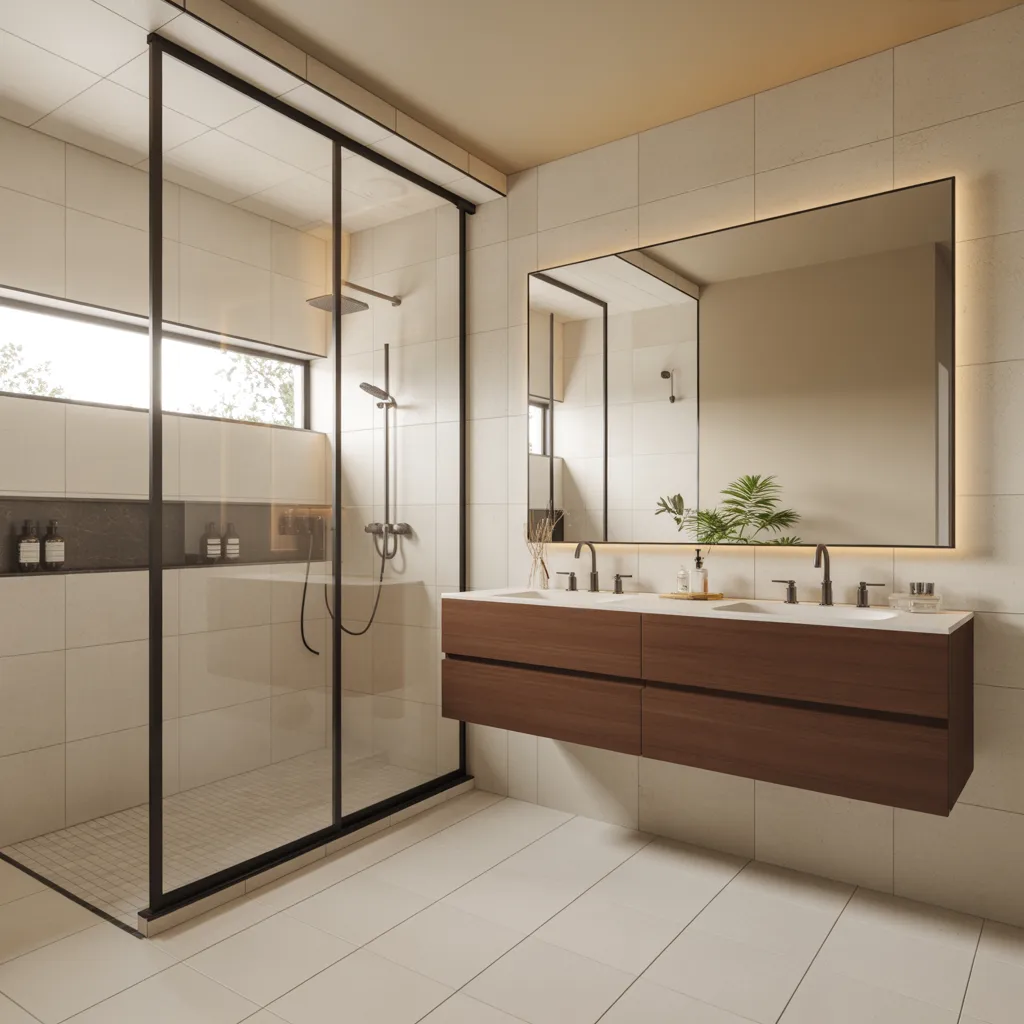
A floating vanity — wall-mounted with no legs touching the floor — is one of the clearest visual signals of a modern bathroom. The floor appears to extend continuously under the vanity, which makes the room feel larger. The gap below the vanity allows light to travel under it, which brightens the floor area. And practically, cleaning the bathroom floor becomes significantly easier when there are no legs, no base cabinet, no corners where dust accumulates. It’s a detail that looks good, reads as contemporary, and actually makes the bathroom more livable.
Floating vanities require the plumbing to be routed through the wall rather than up from the floor, which is a renovation consideration worth planning for from the start. The vanity unit itself runs about $400-1,200 for a quality wall-mounted version in the 36-60 inch range, from brands like IKEA’s Godmorgon system or more premium options from RH or West Elm. Pair a floating vanity with a light-colored countertop — white quartz or honed marble in the $50-100 per square foot range — to maximize the light-reflecting quality of the installation.
Frameless Glass Shower Modern Bathroom Idea
A frameless glass shower enclosure removes the visual boundary between the shower zone and the rest of the bathroom. Without the thick metal frame of a standard shower door, the eye travels through the glass and the bathroom reads as a single, larger space. Frameless glass also photographs dramatically better than any alternative — which is partly why it appears in virtually every high-end bathroom renovation you’ve ever seen. But beyond aesthetics, it’s genuinely easier to keep clean because there are no frame channels to accumulate soap scum.
A frameless glass shower panel or door costs more than a framed version — budget $800-2,500 depending on size and whether it’s a panel, a single door, or a full enclosure. The investment is significant, but it’s also one of the changes that adds the most real estate value to a bathroom renovation. Specify low-iron glass rather than standard glass for the clearest, least-green appearance. Apply a quality water-repellent coating like Rain-X or a professional hydrophobic treatment — it dramatically reduces cleaning frequency and keeps the glass looking pristine with minimal effort.
Layered Bathroom Lighting Idea
Bathroom lighting is where most renovations fail most completely. A single overhead light produces unflattering shadows directly below — under the chin, nose, and eyes — that make the room feel clinical and make grooming genuinely difficult. Modern bathroom lighting uses at least three sources: overhead ambient light for general illumination, side lighting beside or above the mirror for shadow-free grooming light, and accent lighting for atmosphere. The difference between one overhead light and a properly layered bathroom lighting plan is dramatic.
Side lighting at the mirror is the single most impactful bathroom lighting upgrade available. Vertical light bars or sconces mounted at face height on either side of the mirror eliminate grooming shadows completely — the light wraps around the face rather than casting it into shadow from above. Options from Rejuvenation or Amazon run about $60-200 per sconce. A backlit LED mirror ($150-400 from Amazon or Wayfair) achieves a similar effect with a single fixture. Put the overhead light on a dimmer for evening use and the bathroom transforms from a functional room into something genuinely pleasant to be in at any time of day.
Matte Black Fixtures Modern Bathroom Idea
Matte black fixtures have become one of the defining details of contemporary bathroom design, and for good reason. The flat, non-reflective finish is graphic and bold without being shiny or ostentatious. It shows water spots significantly less than polished chrome, which is a practical advantage in a wet environment. And it pairs with an unusually wide range of tile colors and vanity materials — white, warm wood, stone, grey — which makes it one of the more versatile hardware finish choices available.
Converting a bathroom to matte black fixtures — faucet, showerhead, towel bars, toilet paper holder, robe hook, drain covers — costs between $200-600 depending on the quality of the fixtures and whether you’re doing it yourself or hiring a plumber. Delta, Moen, and Kohler all make excellent matte black collections in the $80-200 per fixture range. The key is buying all fixtures from the same manufacturer’s matte black finish — matte black varies significantly between brands and mixed finishes look worse than mismatched chrome would.
Natural Stone Modern Bathroom Idea
Natural stone in a bathroom brings warmth and depth that no manufactured material fully replicates. The variation in veining, color, and texture that makes stone beautiful also makes every installation unique. Marble, travertine, slate, and limestone all have their own character — and that character is what makes a stone bathroom feel genuinely luxurious rather than just expensive. The maintenance requirements are higher than porcelain, but for a master bathroom where the quality of the material is a daily experience, the trade-off is worth considering.
White Carrara marble is the most classic option — available in tile form for about $8-20 per square foot, or as a slab for countertop applications at $60-100 per square foot installed. Travertine adds Mediterranean warmth and costs about $5-15 per square foot for tile. For those who want the stone look without the maintenance, high-quality porcelain in stone-look finishes has become convincingly realistic — the best versions are difficult to distinguish from real stone at normal viewing distance and cost $3-8 per square foot. Either way, the stone aesthetic is one of the most reliably beautiful approaches available in modern bathroom design.
Shower Niche Modern Bathroom Idea
A recessed shower niche — a shelf built into the shower wall during construction or renovation — solves the shower storage problem without a single product on the shower floor or hanging from the showerhead. No wire basket cluttering the view, no bottles balanced on the ledge of the tub, no shampoo bottles lined up in a visual row along the shower floor. A niche keeps products accessible, organized, and out of sight, and it contributes to the clean visual lines of a modern shower in a way that surface-mounted storage never manages.
A shower niche must be planned during the tile installation — it’s built into the wall before tiles go on, not added afterward. Standard dimensions are 12 inches wide by 24 inches tall, which holds most shower products comfortably. Tiling the interior of the niche in a contrasting material or color — a strip of mosaic tile, a darker grout, a different tile format — turns functional storage into a deliberate design detail. Budget about $200-500 in additional labor for the niche during a shower renovation, which is among the best value-per-impact additions available in a bathroom project.
Heated Floor Modern Bathroom Idea
Heated bathroom floors are one of those upgrades that sounds indulgent until the first cold morning when you step onto a warm floor instead of cold tile. Then it feels less like a luxury and more like a fundamental quality-of-life improvement that you can’t believe you lived without. Electric radiant floor heating installs beneath the tile and connects to a wall thermostat that can be programmed to warm the floor before you wake up. The installation cost is modest relative to the daily comfort it provides.
Electric radiant floor heating is installed before the tile goes down — it’s a flat heating mat that lies on the floor substrate and connects to a thermostat on the wall. A typical small bathroom of 40-60 square feet runs about $300-600 in materials and $200-400 in installation labor. The operating cost is minimal — a small bathroom floor runs for about $0.25-0.50 per hour to heat. A programmable thermostat set to warm the floor 30 minutes before your usual wake time means the bathroom is always warm when you need it. Nuheat and Warmup are two reliable brands for residential electric radiant heating.
Freestanding Bathtub Modern Bathroom Idea
A freestanding bathtub is the most dramatic single element in a modern bathroom — it reads as sculptural rather than functional, occupies the room as a centerpiece rather than a fixture pushed against a wall, and communicates a level of design intention that no built-in tub quite achieves. In a master bathroom with adequate floor space, a freestanding bath transforms the room from a functional space into something closer to a private retreat. It’s visible as the first thing you see when entering the bathroom, which makes it the most powerful focal point available.
Freestanding tubs require at least 5×8 feet of floor space beyond the tub footprint itself for the room to feel comfortable rather than cramped. Modern freestanding tub styles range from classic clawfoot to completely minimalist oval or rectangular forms that sit directly on the floor with no feet. Budget $800-2,500 for a quality acrylic freestanding tub; cast iron options run $2,500-5,000 and retain heat significantly longer. Pair with a floor-mounted tub filler (a freestanding faucet that rises from the floor beside the tub) rather than a wall-mounted option for the most design-forward result.
Vanity Mirror Upgrade Modern Bathroom Idea
The mirror in a bathroom does more work than almost any other element — it’s used multiple times daily, it affects the quality of the lighting (by reflecting it), it defines the visual scale of the vanity area, and it contributes significantly to the style of the room from across the space. Most builder-grade bathrooms have a basic frameless beveled mirror that does the functional job adequately and nothing more. Replacing it is one of the fastest and most affordable modern bathroom upgrades available.
An arched or round mirror above a rectangular vanity creates visual contrast that makes both the mirror and the vanity more interesting. LED backlit mirrors ($150-400 from Amazon, Wayfair, or Costco) provide excellent grooming light and look genuinely high-end. A large horizontal mirror that spans the full vanity width makes a small bathroom feel significantly wider. An antique or ornate frame in a room otherwise defined by clean contemporary lines creates an interesting tension that feels deliberately designed rather than accidentally mixed. Replace the mirror before the hardware and before the tile — it has more visual impact per dollar spent than either.
Bathroom Plant Modern Bathroom Idea
Plants in a bathroom counterbalance what can otherwise be an entirely hard-surface room — tile, glass, metal, porcelain. One well-chosen plant changes the quality of the space in a way that’s immediately felt but hard to articulate. It adds organic color and texture, softens the hard edges, and makes the bathroom feel inhabited rather than institutional. In a room where everything else is manufactured, a living plant is the detail that makes it feel like someone actually chose how to live in this space.
High-humidity tolerant plants thrive in bathroom conditions — ferns, peace lilies, orchids, pothos, snake plants, and ZZ plants all do well with the moisture and temperature that most bathrooms provide. For bathrooms with natural light, the options expand considerably. For windowless bathrooms, pothos and snake plants survive with almost no natural light. A quality ceramic planter in the vanity’s color palette — a matte white planter beside a white vanity, a terracotta pot in a warm stone bathroom — makes the plant feel like a design choice rather than an afterthought. Budget $15-50 total for plant and planter.
Bathroom Hardware Consistency Modern Idea
Hardware is the jewelry of a bathroom — small individually, but collectively defining the room’s finish level and design coherence. The towel bars, toilet paper holder, robe hook, cabinet pulls, faucet, and showerhead are all small pieces that add up to a statement about how carefully the bathroom was put together. Mixed finishes in a bathroom — chrome towel bar, brass faucet, nickel hooks — create a visual noise that makes the room feel assembled rather than designed, regardless of how nice the individual pieces are.
The most reliable approach is buying all bathroom hardware from a single manufacturer’s collection in a single finish. This guarantees color consistency across pieces, since matte black (for example) varies between manufacturers in ways that are visible when pieces are next to each other. A complete bathroom hardware set — towel bars, toilet paper holder, robe hook, and hand towel ring — from Moen, Delta, or Kohler in the same finish runs about $150-400. It’s a modest investment that has a meaningful effect on how finished and considered the bathroom feels as a whole.
Wet Room Modern Bathroom Idea
A wet room — a bathroom where the shower area is not separated by a screen or threshold but where the floor slopes continuously to a central drain and the whole space is waterproofed — is the most spatially open and architecturally sophisticated bathroom format available. With no shower enclosure breaking the visual field, the bathroom reads as a single unified space. The floor slopes gently toward the drain, managing water without any visible containment. It’s the format that appears in the most design-forward hotel bathrooms for a reason.
Wet rooms require comprehensive waterproofing throughout — this is not a project to cut costs on, because the consequence of inadequate waterproofing is water damage to the structure. Budget $3,000-8,000 for a properly executed wet room conversion in a standard bathroom, including waterproofing membrane, new floor drain, and tile. Continuous large-format stone or porcelain tile from floor to ceiling throughout creates the most immersive and cohesive result. The investment is significant, but for a master bathroom that will be used daily for years, a well-executed wet room is among the highest-quality bathroom experiences available in residential design.
Bathroom Towel Warmer Modern Idea
A heated towel rail is one of those bathroom additions that seems like a minor luxury until you’ve used one through a winter. Warm, dry towels every morning. No damp towel smell developing between uses because the towel dries completely rather than sitting wet. A wall element that adds visual warmth to an otherwise hard-surfaced room. And for bathrooms without great ventilation, the heated rail reduces humidity by drying towels faster, which also helps control mildew. It’s a genuine quality-of-life improvement that happens to look good.
Electric towel warmers don’t require plumbing changes — they mount to the wall and plug into a standard outlet or are hardwired. A quality electric model from Mr. Steam or Warmly Yours in the right finish to match your fixtures runs about $150-400. They heat quickly (most are warm within 10-15 minutes) and consume minimal electricity — about the same as a standard light bulb. Choose a finish that matches your other bathroom hardware — matte black, brushed brass, or chrome — so the towel warmer reads as part of the room’s design rather than an add-on.
Bathroom Storage Built-In Modern Idea
A modern bathroom that lacks adequate storage becomes one covered in products — things lined up on the counter, hanging from the showerhead, stored on the back of the toilet, balanced on the edge of the tub. Built-in storage — recessed medicine cabinets, vanity with deep drawers, built-in shelving between wall studs, a niche beside the mirror — keeps the bathroom surfaces clear and the room looking calm and considered. In a room where every surface is visible and where clutter reads as particularly disorganizing, adequate storage is a design decision as much as a practical one.
A recessed medicine cabinet mounted flush with the wall surface adds significant mirrored storage without protruding into the bathroom at all — options from Kohler or Robern run about $200-600 depending on size and features. A vanity with deep drawers rather than open shelving below holds far more than it appears to from the outside and keeps everything out of sight. Between-stud recessed shelving beside the vanity or shower adds display and storage space within the wall cavity at no additional floor footprint — a carpenter can add these for about $200-500 per niche.
Bathroom Robe Hook Modern Idea
A robe hook positioned in the right location in a bathroom is one of those small details that makes daily life slightly better in a way you feel every morning. It’s where the robe goes when you shower. Where the towel hangs when you’re getting dressed. Where tomorrow’s outfit can be hung if the bathroom is used for getting ready. Most bathrooms have one hook in the wrong place, or no hook at all, which means robes end up on the floor or draped over the door. Two hooks in the right locations — one near the shower, one near the mirror — fix this completely.
A quality robe hook from Rejuvenation, Schoolhouse, or the same manufacturer as your other bathroom hardware runs about $20-50 each. Two hooks in the right finish and the right positions costs $40-100 total and makes a meaningful improvement to how the bathroom functions daily. Mount one at 65-70 inches from the floor for robes and towels; add a second at 45-50 inches for a hand towel near the sink. The investment is minimal. The daily impact is not.
Bathroom Window Treatment Modern Idea
Windows in a bathroom present a design challenge that most people solve badly — either with flimsy frosted window film, cheap roll-up shades, or nothing at all. A bathroom window deserves a treatment that provides privacy without sacrificing natural light, and that contributes to the room’s aesthetic rather than fighting it. The right window treatment for a modern bathroom is one that does both: functional and beautiful simultaneously.
A Roman shade in a moisture-resistant fabric — linen with a water-resistant treatment, or a synthetic linen-look in an outdoor-grade fabric — works well in a bathroom environment and looks clean and contemporary. Bamboo roller shades provide privacy with a natural material texture that works beautifully in a stone or wood bathroom. For maximum light with complete privacy, frosted glass applied to the window itself (about $15-30 per window from a hardware store as a film) eliminates the need for a shade entirely. Any of these costs under $100 and significantly improves how the window reads in an otherwise carefully designed bathroom.
Bathroom Finishing Details Modern Idea
The finishing details of a modern bathroom are the things nobody specifically notices when they’re done correctly but that everyone notices when they’re wrong. The grout color that was specified without testing it. The outlet covers that don’t match the wall color. The caulk around the tub that was applied too thick. The toilet paper holder that’s three inches lower than it should be. These small details accumulate into a bathroom that feels almost finished rather than completely done, and most of them are entirely avoidable with a bit of attention.
Grout color should be tested on a sample board in the actual tile before committing — grout dried looks significantly different from grout wet, and many people are surprised by how much the final color differs from what they expected. Outlet covers painted to match the wall color (or replaced with modern flush-mount versions from Leviton for about $5-8 each) disappear rather than interrupting the wall surface. Fresh caulk around the tub and shower edges makes even an older bathroom look significantly newer. These finishing details are the difference between a bathroom that was renovated and one that was finished.
FAQs About Modern Bathroom Ideas
What modern bathroom ideas make the biggest difference without a full renovation?
Replacing the mirror with a backlit LED version, upgrading all hardware to a consistent matte black or brushed brass finish, adding side lighting at the vanity mirror, and fresh paint or a bold wall color are the four changes that transform a bathroom most dramatically without touching the tile or plumbing. Together these typically cost $300-700 and address the most visible elements of the bathroom. The lighting change alone — moving from a single overhead to layered sources — has more immediate impact than almost any other single change.
What tile is best for a modern bathroom?
Large-format porcelain tile (24×24 inches or larger) in a warm white, light grey, or stone-look finish is the most versatile modern bathroom tile choice because it reads as spacious, clean, and contemporary in almost any bathroom. For a bolder statement, large-format dark tile with minimal grout lines reads as dramatic and sophisticated. Zellige handmade tile adds warmth and artisanal texture that works beautifully in a modern bathroom with natural material accents. Avoid busy patterns and small mosaic tiles on main surfaces — they read as dated in a modern context.
How do I add warmth to a modern bathroom that feels too cold?
Warm-toned materials are the most effective answer — a wood vanity or wood-look cabinet, natural stone or stone-look tile in a warm beige rather than cool grey, warm white paint rather than bright white, and warm brass fixtures rather than cool chrome. Lighting at 2700K (warm white) rather than 4000K or higher makes an immediate difference. A plant adds organic color. A natural fiber rug or a bath mat in a warm tone softens the floor. Together these shifts move a bathroom from cold and clinical to warm and inviting without changing the tile or the plumbing.
What is the most cost-effective modern bathroom upgrade?
Updating all bathroom hardware to a consistent finish is probably the highest-return upgrade available — it costs $150-400 total, takes a few hours of DIY installation, and has an immediate and significant effect on how finished and contemporary the bathroom reads. After hardware, a new vanity mirror (especially a backlit LED version) and fresh paint are close runners-up. All three together typically cost $400-700 and make a bathroom look genuinely renovated without touching the tile, plumbing, or major fixtures.
How much does a modern bathroom renovation cost?
A cosmetic refresh — new paint, hardware, mirror, lighting, and accessories — typically runs $500-1,500 DIY or $1,500-3,000 with professional help. A mid-range renovation involving new tile, vanity, toilet, and shower fixtures runs $8,000-20,000 depending on size and material choices. A high-end master bathroom renovation with custom tile, stone countertops, frameless glass shower, freestanding tub, and heated floors can run $25,000-60,000+. The sweet spot for most homeowners is the mid-range renovation, which adds significant real estate value while delivering a daily experience that’s meaningfully better than what it replaced.
Conclusion of Modern Bathroom Ideas
A modern bathroom that works is one where every decision was made deliberately — the tile that reflects enough light to make the room feel open, the lighting that actually works for getting ready in the morning, the storage that keeps surfaces clear, the hardware that reads as a cohesive finish rather than an accidental accumulation of different metals. These decisions, made carefully and with genuine attention to how the room will be used every day, are what separate a bathroom that’s been renovated from one that’s been designed.
Start with whatever causes the most daily frustration in your bathroom right now. Poor lighting at the mirror? Fix that first. No storage that keeps the counters clear? Address that next. Hardware that’s inconsistent and cheap-looking? That’s an afternoon of DIY and a modest budget. One good decision in a bathroom tends to make the next one clearer, and the bathroom that results from those decisions is one that makes getting ready every morning something closer to a pleasure than a chore.