24 Bedroom Interior Ideas That Turn Any Room Into a Space You Actually Love
A bedroom interior that works isn’t just about how the room looks in photos. It’s about how it feels at seven in the morning when you’re half awake, and at ten at night when you finally get to stop moving. It’s the quality of the light when you read before sleep. The way the room smells when you walk in after a long day. Whether the furniture arrangement makes sense for how you actually move through the space. Most bedrooms fail this test not because they’re ugly but because they were never really designed for the person sleeping in them.
This list covers 24 bedroom interior ideas that address all of it — the large decisions like color and layout, the mid-level decisions like furniture and lighting, and the small details that most people skip but that make the biggest difference in how a room actually feels to be in. Whether you’re starting from scratch or refreshing what you already have, there’s a path forward here that doesn’t require a designer budget or a full renovation.
Best Bedroom Interior Ideas to Try in Your Home
The best bedroom interiors share something that’s easy to miss in design media: they feel personal. Not just styled, not just coordinated, but genuinely reflective of the person who lives in them. The art means something. The colors were chosen rather than defaulted to. The furniture fits the room rather than fighting it. That quality of intention is what separates a bedroom that looks good from one that feels right.
What follows covers the full range of bedroom interior decisions — from the foundational ones that define the room’s character to the finishing details that make it feel complete. Some are free. Some require investment. All of them are worth knowing if you want a bedroom that genuinely works for you rather than a room you just happen to sleep in.
Bed Placement Idea
Most people put the bed wherever it fits without thinking much about it. But bed placement is one of the most consequential interior decisions in a bedroom, because every other piece of furniture is positioned in relation to it. The wrong placement makes a room feel unresolved no matter how carefully everything else is arranged. The right placement anchors the room and makes the whole layout feel intentional from the moment you walk in.
The general principle: the bed should face the door — not directly opposite it, but positioned so the person in bed can see the entrance without being directly in line with it. This is partly practical (you see who’s coming in) and partly psychological (it creates a sense of security that affects sleep quality without you being consciously aware of it). Center the bed on the main wall rather than pushing it into a corner wherever possible — symmetry around the bed is one of the clearest signals of a thoughtfully designed bedroom interior.
Layered Lighting Bedroom Interior Idea
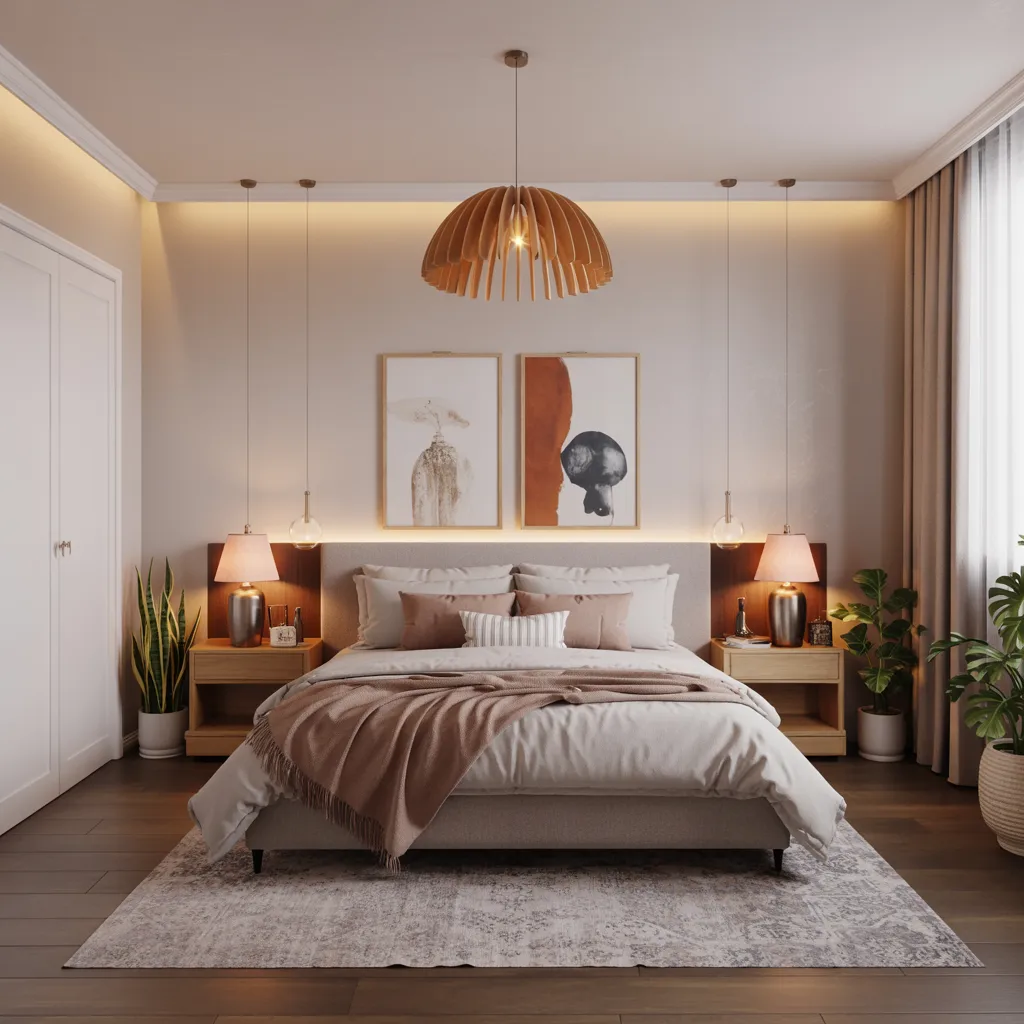
The bedroom interior that feels most like a retreat almost always has layered lighting — multiple sources at different heights working together to create depth and warmth. A single overhead light flattens the room and makes it feel like an office. Three sources — overhead for general illumination, bedside for task lighting, accent for atmosphere — transform the same room into something that shifts mood from morning to night.
Overhead light on a dimmer switch. Bedside lamps with warm bulbs at 2700K. A floor lamp in a corner, or LED strips behind the headboard for ambient glow. Smart bulbs from Philips Hue or IKEA’s Tradfri system let you control all three from one app — or set them to shift automatically from bright in the morning to warm and dim by evening. The full layered lighting setup typically costs $100-200 total and is one of the highest-return bedroom interior investments available.
Headboard Focal Point Idea
Every well-designed bedroom interior has a clear focal point — the thing your eye goes to first when you enter the room. In almost every case, that should be the wall behind the bed. How you treat that wall sets the tone for the entire room. A beautiful headboard is the most direct way to create that focal point, and it has the added benefit of being genuinely functional — comfortable for reading, sitting up in bed, and leaning against in the morning.
An upholstered headboard in linen, velvet, or boucle fabric adds immediate warmth and sophistication to any bedroom interior. Wayfair and Amazon both carry solid options starting around $150-250 for a queen. If the budget is tight, a DIY upholstered headboard using plywood, foam, fabric, and a staple gun costs about $60-100 in materials and looks genuinely professional when done carefully. Go tall — at least 48 inches — for the most dramatic and design-forward result.
Bedroom Interior Color Palette Idea
Color is the decision that sets the emotional character of a bedroom interior before a single piece of furniture is placed. Warm colors — terracotta, warm cream, dusty rose — make a bedroom feel cozy and intimate. Cool colors — pale blue, soft grey, sage green — make it feel calm and airy. Neutrals — warm white, greige, oat — make it feel clean and versatile. None of these is objectively better. The right choice is the one that makes you feel the way you want to feel in your bedroom.
The most reliable approach for a bedroom interior: choose one dominant color for the walls and large textiles, one secondary color for accent cushions and throws, and one neutral to ground everything. Keep the palette to three colors maximum — more than three competing tones make a bedroom feel busy rather than rich. Benjamin Moore’s Pale Oak is one of the most popular bedroom neutrals right now, warm enough to feel cozy but light enough to read as sophisticated rather than beige.
Bedroom Interior Rug Placement Idea
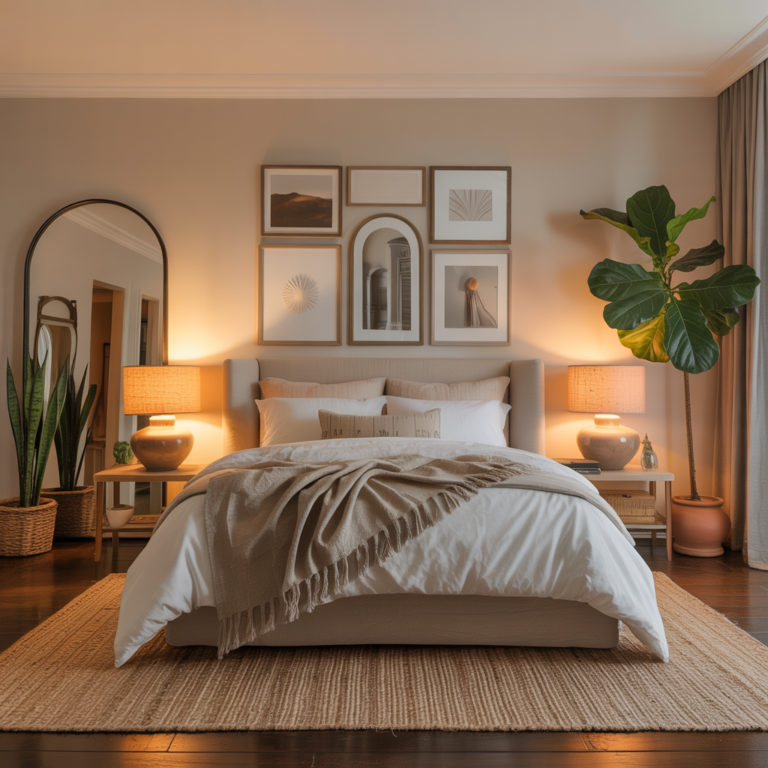
A rug anchors the entire bedroom interior in a way that’s hard to achieve through any other single piece. Without a rug, even a beautifully furnished bedroom can feel incomplete — like the furniture is floating rather than belonging to the space. With a rug in the right size and the right placement, the room suddenly coheres. Everything relates to each other. The bed, the nightstands, the dresser — they all feel like they’re part of the same intentional arrangement.
The rug should extend at least 18 inches beyond each side of the bed, with the front legs of the bed frame sitting on the rug. For a queen bed, that typically means an 8×10 rug at minimum. A 9×12 looks even better if the room allows it. Natural fiber rugs — jute, sisal, wool — look and wear better than synthetic alternatives in bedroom applications. A good quality wool rug from Rugs USA or Loloi in the 8×10 size range runs $150-400 depending on pile and pattern.
Bedroom Interior Curtain Idea
Curtains in a bedroom interior do three things at once: they control light, add softness to what can otherwise be a room of hard surfaces and straight lines, and contribute significantly to the room’s overall character. The fabric and color of the curtains are visible from across the room and from the doorway — they have a larger visual footprint than most people realize when they’re shopping for them from a picture on a screen.
Linen curtains in warm white or cream work in almost every bedroom interior style and age gracefully. Velvet curtains in a muted jewel tone — dusty teal, deep sage, warm burgundy — add richness and excellent light blocking. Always hang curtain rods at ceiling height, not window frame height, and always use floor-length panels. IKEA’s Majgull blackout linen-look curtains at about $25-40 per panel are one of the best budget options available — they’re dense enough to block most light and look far more expensive than they are.
Bedroom Interior Texture Layering Idea
A bedroom interior that looks flat almost always has a texture problem — everything’s smooth, everything’s the same visual weight, and nothing stands out because nothing contrasts. Texture is what creates depth and richness in a room, and in a bedroom where the color palette tends to be restrained, texture does the work that pattern does in other rooms. It’s the difference between a room that looks expensive and one that looks like a hotel catalog.
Layer at least four different textures in a bedroom interior: smooth (linen or cotton sheets), nubby (boucle cushion or knit throw), natural (jute rug or rattan lamp), and one smooth-hard surface (ceramic lamp base, stone tray on nightstand). You don’t need to spend much — H&M Home, Zara Home, and Target all carry excellent textural textiles for under $30 per piece. The combination is what matters more than the individual cost of each element.
Bedroom Interior Storage Solution Idea
A bedroom interior falls apart the moment storage runs out. The nightstand gets piled with things that belong elsewhere. The floor gets covered with clothes waiting for a home. The surfaces become landing zones rather than intentional displays. Good bedroom interior design anticipates this and builds storage into the room in a way that keeps everything contained without making the room feel like a storage unit.
A storage bed is the most efficient solution — it holds the equivalent of a full dresser without any additional floor footprint. A built-in wardrobe that reaches the ceiling uses every inch of vertical space available. Floating shelves replace freestanding bookcases and free up floor area. Under-bed rolling bins handle seasonal items invisibly. The goal is enough storage that nothing needs to live on the floor, the chair, or the top of the dresser except what’s been consciously placed there.
Bedroom Interior Plant Idea
Plants in a bedroom interior do something that no piece of furniture can replicate — they bring actual life into the space. A well-placed plant changes the energy of a bedroom in a way that’s hard to fully explain but immediately felt. And practically speaking, they add color, organic texture, and vertical interest to corners and surfaces that might otherwise feel empty or underdressed.
A large fiddle leaf fig or monstera in a quality ceramic planter makes a dramatic statement in an underused corner and costs about $40-80 total from a local nursery plus IKEA for the planter. For bedrooms with limited light, a snake plant (Sansevieria) or ZZ plant thrives with almost no natural light and very little water — about $15-25 each from a hardware store or nursery. One large plant does more for a bedroom interior than three small ones scattered around the room.
Bedroom Interior Art Selection Idea
Art personalizes a bedroom interior in a way that nothing else quite does. It tells the story of who lives in the room before a single conversation. Generic mass-market art — the kind sold in matching sets — makes even a well-furnished room feel anonymous. Art that was chosen because it genuinely resonated with the person who chose it makes the same room feel inhabited and real. The price matters far less than the choice.
One large piece above the bed makes more impact than multiple small pieces scattered around the room. Print your own travel photography at a local shop — a 16×20 print runs about $8-15, and framed, it’s art nobody else has. Society6 and Etsy both have original prints from independent artists for $20-60. For a more investment-worthy piece, local art fairs and small galleries often sell originals in the $100-300 range that become more meaningful over time. The best bedroom art is always something you actually love.
Bedroom Interior Nightstand Styling Idea
The nightstand is one of the most visible surfaces in a bedroom interior and one of the most consistently treated as a dumping ground. Whatever was in your hands when you got into bed lands there — phone, charger, glasses, half-drunk glass of water, book from last week. A styled nightstand is not about being precious or tidy for its own sake. It’s about giving things a proper place so the surface reads as intentional rather than accumulated.
The formula that works in almost any bedroom interior: one lamp (the right height, warm bulb), one plant or small vase, one book (current read, stacked horizontally), one small tray for daily items like glasses and jewelry. That’s it. A ceramic tray from Target or World Market runs about $10-15 and does the organizational work of keeping the surface legible. Everything in a tray reads as organized; everything scattered reads as clutter, regardless of the individual quality of the items.
Bedroom Interior Accent Wall Idea
An accent wall behind the bed is the most straightforward way to add a focal point to a bedroom interior without repainting the whole room or committing to wallpaper on all four walls. Done well, it makes the bed feel intentionally framed and the room feel more designed. Done poorly — wrong color, wrong wall, wrong execution — it just looks like one wall didn’t get finished. The difference is almost entirely in the color choice and the commitment to following through fully.
Deep navy, forest green, warm terracotta, rich charcoal — any of these work on a bedroom accent wall when paired with complementary bedding. Paint it fully, from baseboard to ceiling, without any half-measures. One can of Sherwin-Williams or Benjamin Moore paint covers a standard wall for about $50-70. For something with more texture and interest, limewash paint from brands like Portola Paints creates a beautiful variegated, aged effect for about the same cost that photographs dramatically.
Bedroom Interior Scent Idea
Scent is the bedroom interior detail that most design articles skip entirely, which is a genuine oversight. The olfactory experience of a room is processed faster than the visual one — your body registers how a room smells before you’ve consciously looked at anything. A bedroom that smells like lavender, sandalwood, or clean linen communicates rest and calm immediately. A bedroom that smells like nothing in particular, or stale air, undermines even the most carefully designed interior.
A reed diffuser on the dresser or nightstand provides continuous, subtle scent without any daily effort. Vitruvi makes excellent options in the $30-50 range. Lavender, eucalyptus, white tea, and cedar are all reliably calming bedroom scents — avoid anything too energizing or sweet for a sleep space. A quality soy candle in the evenings adds warmth and ritual alongside the scent. The consistency is what matters most: the same scent, every night, trains your brain to associate it with sleep.
Bedroom Interior Dresser Styling Idea
The dresser top is among the highest-visibility surfaces in a bedroom interior and among the most reliably messy. It accumulates receipts, loose change, jewelry that didn’t make it to the tray, chargers, random objects. Styling it deliberately takes about twenty minutes and immediately improves how the entire room reads. A cluttered dresser makes even a beautiful bedroom interior feel chaotic; a styled one ties the room together.
Clear everything off. Then put back only what you choose to display: a small mirror leaned against the wall behind it, a tray for daily essentials, a plant or vase, one or two intentional objects. Nothing random, nothing apologetic. A small marble or wood tray from H&M Home or Target runs $10-20 and organizes the daily items into a contained unit. Leaning a round mirror against the wall behind the dresser rather than hanging it makes the whole setup feel relaxed and considered at the same time.
Bedroom Interior Ceiling Treatment Idea
The ceiling in a bedroom interior is the surface you look at when you’re lying in bed — which makes it more visually important than its neglect would suggest. Most bedrooms have ceilings that are just white and flat and forgotten. A small investment in the ceiling creates a bedroom interior that feels genuinely complete rather than 90 percent finished. And unlike many other changes, a ceiling treatment is something you notice and appreciate every single night.
The simplest option: paint the ceiling a slightly deeper shade than the walls, or the same color as the walls for a cocooning effect. A warm greige ceiling in a warm white room reads as sophisticated and enveloping. String lights hung in a loose grid across the ceiling cost about $25 on Amazon and create incredible warmth. A wood beam — real or faux — mounted above the bed adds architectural character for $50-150 depending on size. Any of these changes the bedroom interior significantly for minimal investment.
Bedroom Interior Window Treatment Idea
Window treatments in a bedroom interior are doing two jobs simultaneously: controlling light and privacy for sleep quality, and contributing to the room’s overall aesthetic. Most windows need both a functional layer (blackout or light-dimming) and a decorative layer (sheer or textured fabric) to do both jobs well. A single layer almost always compromises on one or the other.
The most effective combination: a Roman shade or roller blind in a blackout fabric for full light control, paired with floor-length sheer curtains on either side for softness and style. The sheer panels add the visual warmth and ceiling-height illusion of curtains without blocking light during the day when the blinds are up. This two-layer approach costs about $80-150 total using IKEA for the sheers and a basic blackout roller from Home Depot or Amazon — significantly less than custom window treatments with the same functional result.
Bedroom Interior Personal Touch Idea
The bedroom interior that feels most like home is the one with personal meaning built into it — not the one with the most expensive furniture or the most carefully curated aesthetic. A framed photograph from a trip that changed you. A small object inherited from someone you loved. A piece of art you saved up for because you genuinely wanted it. A stack of books by writers who matter to you. These things cost nothing in design terms. They cost everything in terms of how the room feels to be in.
Three or four meaningful objects placed intentionally are worth more to a bedroom interior than twenty generic decorative pieces chosen because they matched the color scheme. A framed personal photograph printed at Walgreens or CVS for $3-8 and placed in a simple frame becomes art that nobody else in the world has. A small inherited object on the nightstand connects the room to something larger than just design. These personal elements are what make a styled room feel genuinely lived in rather than staged.
Bedroom Interior Technology Management Idea
Technology in a bedroom interior is one of the most underaddressed design challenges in modern homes. Phones, chargers, tablets, smart speakers — they accumulate on nightstands and dressers and create visual clutter that’s hard to style around because the objects themselves are designed to be functional rather than beautiful. Managing this without sacrificing convenience is a small but meaningful bedroom interior improvement that most people never think to address.
A nightstand with a built-in wireless charging pad (CB2 and West Elm both make versions in the $150-200 range) eliminates charging cables entirely from the visible nightstand surface. A small wooden or leather cord organizer from Amazon at $10-20 gathers remaining cables into a contained unit. A simple rule: if it’s not being used in the next eight hours, it goes in a drawer rather than on the surface. Technology managed invisibly is one of the clearest signs of a thoughtfully designed bedroom interior.
Bedroom Interior Seasonal Update Idea
A bedroom interior that never changes can start to feel stale in a way that’s hard to identify but easy to feel. The same bedding, the same accessories, the same arrangement — month after month, year after year. Seasonal updates — not full redesigns, just intentional small shifts — keep the room feeling fresh and relevant without requiring the commitment or cost of a full redecoration.
The simplest seasonal update: swap the bedding weight and color. In fall and winter, add a chunky knit throw in a warm tone, switch to heavier linen or flannel sheets, and add an extra pillow in a deep jewel color. In spring and summer, lighten everything — a crisp white duvet, lighter linen, a small plant moved to the windowsill. These swaps cost nothing if you already own seasonal bedding, and they make the bedroom interior feel like it responds to the time of year, which is a small but genuine pleasure.
Bedroom Interior Organization System Idea
The most beautifully designed bedroom interior degrades quickly without an organization system that makes it easy to maintain. And most bedroom organization problems come down to the same root cause: things don’t have designated homes. When there’s no clear place for something, it lands wherever there’s surface space, and surface clutter accumulates faster than most people can manage it just through tidying.
Designate a specific home for every category of item in the bedroom: a tray for daily jewelry and pocket items, a basket for reading material, a hook for tomorrow’s outfit, a small bin for phone and device charging. A label maker from Dymo at $25 makes these designations visible and shareable with anyone else in the household. The system itself costs very little. What it prevents — daily visual clutter and the low-level stress that comes with it — is genuinely worth more than its cost.
Bedroom Interior Sound Management Idea
Sound is the bedroom interior detail that almost nobody addresses intentionally, but that affects sleep quality as directly as light control or mattress quality. A bedroom interior with hard floors, bare walls, and minimal soft furnishings is acoustically live — sounds travel and reflect off surfaces in a way that keeps the room alert and stimulating. A bedroom with rugs, curtains, upholstered furniture, and textile wall hangings is acoustically dead — sounds are absorbed, and the room feels inherently quieter and more restful.
Every textile added to a bedroom interior also improves its acoustics. A thick rug, heavy curtains, an upholstered headboard, a bookshelf full of books — all of these absorb sound and make the room quieter without any specific acoustic treatment. For bedrooms in particularly noisy locations, a white noise machine from LectroFan or Hatch at $30-80 provides consistent masking sound that’s remarkably effective at improving sleep quality. It’s one of the more underrated bedroom interior investments available.
Bedroom Interior Finishing Detail Idea
The finishing details of a bedroom interior are the things nobody specifically notices when they’re done correctly, but that everyone notices when they’re wrong or missing. Crown molding along the ceiling perimeter. Baseboard trim that’s properly painted and caulked. Cabinet hardware that’s consistent and intentional. Light switch plates that match the wall color. These details signal craftsmanship and care — and their absence signals the opposite.
Painting all trim (baseboards, door frames, window frames) a fresh bright white against colored walls is one of the most affordable finishing detail upgrades available — trim paint runs about $20-30 per quart and a bedroom’s worth of trim can typically be painted in an afternoon. Replacing mismatched light switch and outlet covers with a consistent style from Leviton or Lutron costs about $2-5 per plate and takes minutes. These finishing details are small individually but collectively they’re what separate a bedroom interior that feels complete from one that feels almost finished.
FAQs About Bedroom Interior
What makes a bedroom interior feel luxurious without spending a fortune?
Quality bedding, layered warm lighting, a large mirror, and a well-styled nightstand collectively create the impression of luxury at a fraction of the cost of designer furniture. Linen sheets from Parachute in the $100-150 range feel noticeably better than cheaper alternatives. Warm layered lighting removes the overhead-light flatness that makes most rooms feel clinical. A large mirror makes the room feel bigger and more finished. The combination reads as considered and expensive even when the individual elements are quite affordable.
How do I choose a color palette for my bedroom interior?
Start with the feeling you want the room to create — warm and cozy, calm and airy, bold and personal — and work backward from there. Warm tones (terracotta, cream, warm white) create the first. Cool tones (pale blue, soft grey, sage green) create the second. Deep saturated tones (navy, forest green, charcoal) create the third. Choose one dominant color, one secondary, and one neutral to ground them. Keep it to three colors maximum and let texture and material do the work of adding visual interest within that palette.
What bedroom interior changes have the most immediate impact?
In order of impact: layered lighting (especially adding warm bedside lamps and putting the overhead on a dimmer), ceiling-height curtains (makes any room feel taller immediately), a quality area rug in the right size (anchors the room completely), and decluttering the surfaces down to only what’s intentionally placed. These four changes together transform a bedroom interior more quickly and more affordably than any furniture purchase.
How important is the headboard to a bedroom interior?
Very. The headboard is the visual anchor of the bedroom interior — it’s what the bed orients around and what every other design decision responds to. A room without a headboard feels unresolved regardless of how beautifully everything else is designed. And a bad headboard — too small, wrong style, wrong material — drags the whole room down in a way that’s hard to compensate for. Investing in a good headboard, or DIYing one well, is one of the best bedroom interior decisions available.
What’s the best way to start a bedroom interior refresh with a small budget?
Declutter first — it costs nothing and immediately makes the room feel better. Then repaint one wall in an intentional accent color ($50-70 for a can of paint). Swap out the bedding for something in a quality natural fiber ($100-150). Add a warm lamp to each side of the bed ($30-60 each). That sequence — declutter, accent wall, new bedding, warm lighting — transforms a bedroom interior for about $250-350 total and addresses the most impactful elements first.
Conclusion of Bedroom Interior
A bedroom interior that works is one where every decision was made deliberately — not because it was the trendiest choice or the most expensive option, but because it was right for the room and right for the person sleeping in it. The color that makes them feel the way they want to feel. The lighting that shifts with the time of day. The bedding that’s worth the investment because you’re in contact with it every night. The art that means something. These decisions, made one at a time and with genuine intention, are what turn a room you happen to sleep in into a bedroom interior you actually love.
Start with whatever feels most wrong about your bedroom right now. The lighting if it’s harsh. The color if it feels directionless. The clutter if the surfaces are buried. One good decision in a bedroom interior tends to make the next one clearer, and the room that results from that process is one that finally feels like it belongs to you rather than one you’re just borrowing.