27 Laundry Room Organization Ideas That Make Laundry Actually Easier to Do
A disorganized laundry room doesn’t just look bad — it makes laundry harder than it needs to be. Every extra step, every missing surface, every supply you have to hunt for before you can start a load adds friction to a task that already doesn’t need any more reasons to be avoided. Most people don’t realize how much their laundry room is working against them because the friction is so distributed — a few seconds here, a small frustration there — that it never adds up to one obvious problem. It just adds up to something you’d rather put off.
Good laundry room organization removes that friction systematically. When everything has a place, when supplies are within reach, when sorting is built into the system and folding has a dedicated surface, laundry stops feeling like a chore that requires mental effort before you even start. This list covers 27 laundry room organization ideas that address every part of the problem — from the foundational systems to the small details that make the difference between a room that works and one that just has a washer and dryer in it.
Best Laundry Room Organization Ideas to Try in Your Home
The best laundry room organization systems share one quality: they’re easier to maintain than to ignore. When the sorting system is intuitive, items return to it automatically. When supplies are in obvious, accessible locations, they get put back rather than left on the counter. When every category has a designated home, the room stays organized with minimal daily effort rather than requiring a weekly reset. That quality of effortless maintenance is the goal — not a perfect system that requires constant discipline to sustain.
What follows covers the full range of laundry room organization ideas — from large structural changes like folding counters and cabinet systems to small purchases like matching baskets and a label maker that collectively transform how the room functions. Some cost almost nothing. Others are genuine investments. All of them address the laundry room in a way that makes the task it supports genuinely faster and less frustrating.
Three-Bin Sorting System Idea
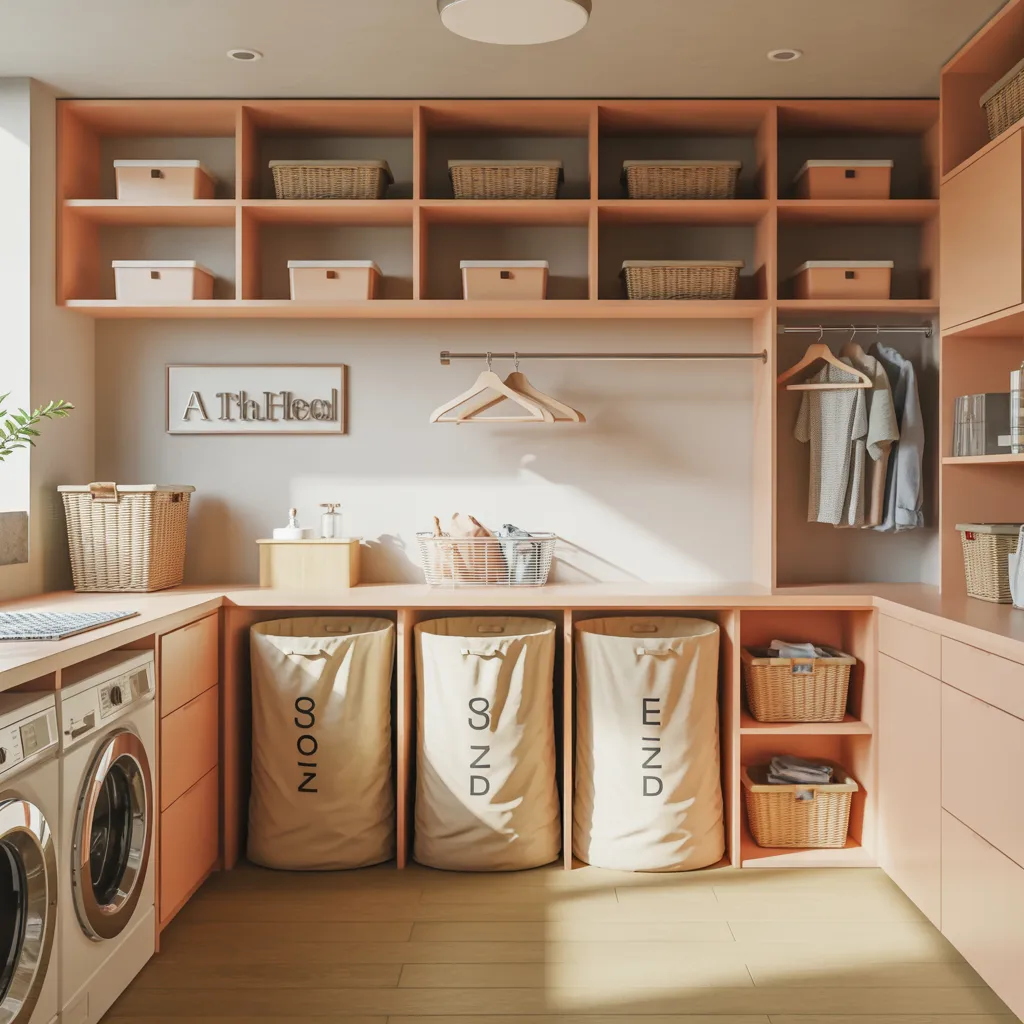
Pre-sorting laundry as dirty clothes are generated — rather than as a step before starting a load — is one of the most time-saving organization changes available in a laundry room. When sorting is already done, laundry day requires nothing more than transferring a bin’s contents directly to the machine. The fifteen minutes of sorting that most people do before every load disappears entirely. Over a year, that’s hours recovered from a task most people would rather spend zero time on.
A three-compartment rolling sorter — one bin each for darks, lights, and delicates — is the most practical option. A good one from Amazon or Wayfair runs about $40-70 and rolls beside or behind the machines when not in use. For smaller laundry rooms, three wall-mounted fabric bags labeled with a label maker take zero floor space and achieve the same result. The system only works if everyone in the household uses it — which means the labels need to be clear, the bins need to be accessible, and the categories need to be simple enough to follow without thinking.
Folding Counter Organization Idea
The folding counter is the single most impactful organizational addition in any laundry room, and most laundry rooms don’t have one. Without a dedicated folding surface, clothes get folded on the dryer lid, on the floor, on the bed in another room — wherever there’s space. These workarounds add steps, create mess in other rooms, and make laundry take longer than it should. A counter directly above or beside the machines makes folding immediate and efficient — clothes come out of the dryer and get folded right there, in the room where laundry happens.
A butcher block counter from IKEA’s Badelunda line in the right size to fit above the machines runs about $80-120 and mounts on simple brackets anchored to wall studs. For stacked machines, a fold-down wall-mounted counter that folds flat when not in use from Amazon or Wayfair runs $60-100. Either option is one of the best value-per-impact laundry room organization investments available. The counter doesn’t need to be large — even 24 inches of flat surface directly accessible from the machines dramatically improves how laundry flows.
Open Shelf Organization Idea
Open shelves above the washer and dryer turn the most available wall space in the laundry room into organized, accessible storage. Supplies that currently live on top of the machines, on the floor, or in no particular location get assigned a proper home at eye level where they’re immediately visible and immediately accessible. The organizational principle is simple: the more visible and accessible a storage location, the more consistently items return to it after use.
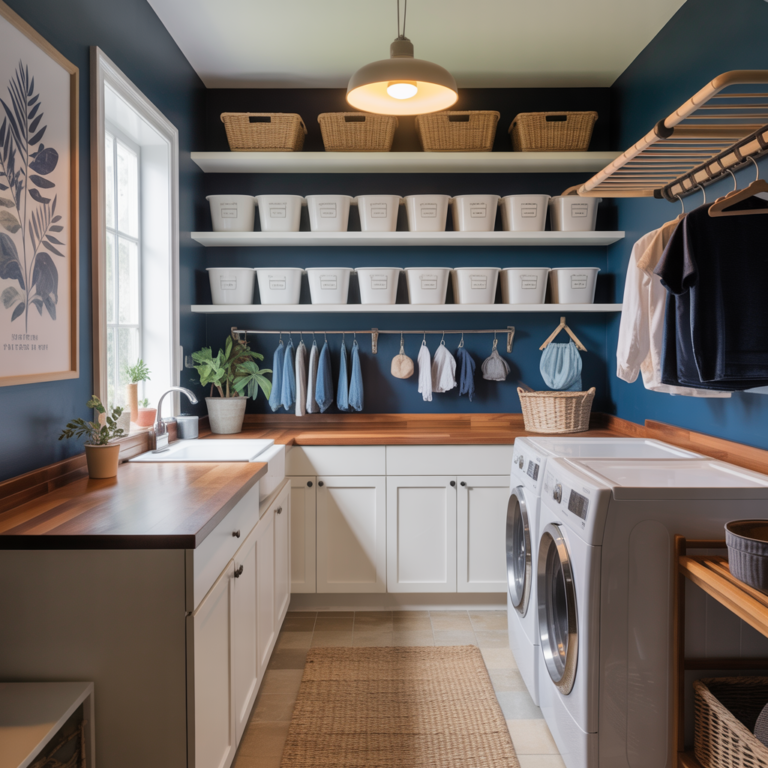
IKEA’s Bergshult shelves with Pershult brackets run about $20-30 per shelf and look clean and intentional mounted above the machines. Use the middle shelf for daily-use supplies — detergent, fabric softener, dryer sheets — at eye level. The upper shelf holds weekly-use items. The top shelf stores seasonal or rarely-used things. Matching baskets on the upper shelves — natural seagrass from Target at $8-15 each — make the shelves look organized even between cleaning sessions. The uniformity of matching baskets signals a system in a way that a random assortment of different containers never does.
Cabinet System Organization Idea
Open shelves look great when they’re organized. Most laundry rooms are not consistently organized, which is why closed cabinets are often the more practical long-term choice. Closed cabinets hide the visual chaos that accumulates between cleaning sessions, create a more finished and polished look, and allow the room to look organized from the doorway even when the interior is not perfectly sorted. In a laundry room that’s also used as a utility space, closed storage is frequently the more realistic and more livable option.
IKEA’s Sektion kitchen cabinet system works perfectly in laundry rooms — the scale is right, the options are extensive, and the cost is significantly lower than custom cabinetry. A basic upper and lower cabinet configuration for a standard laundry room runs about $300-600 depending on the specific modules chosen. Paint the cabinet doors in a color that complements the room rather than the standard white — sage green with brass hardware, navy with chrome, matte white with matte black — and the cabinets read as intentional design rather than installed storage.
Labeled Container System Idea
Labels transform a laundry room from a collection of objects into a readable, shareable system. When bins are labeled, anyone in the household can sort correctly without asking. When supply containers are labeled, you can see at a glance what’s running low without opening them. When shelf sections are labeled, items return to their correct location rather than landing wherever there’s space. The label is the difference between a storage system and a guessing game, and in a shared household space, that difference matters every single day.
A basic Dymo label maker runs about $25-30 and creates clean, consistent labels across every container and shelf section in the laundry room. For a softer look, round chalkboard labels from Amazon at $8-12 for a set look beautiful on glass jars and natural baskets and write cleanly with a chalk pen. Apply labels at the same height across all similar containers for a cohesive look — the uniformity itself signals organization. Once labeled, items are significantly more likely to return to their correct location because the correct location is explicitly clear.
Decanted Supply Organization Idea
Laundry supplies come in packaging designed for retail visibility — large, brightly colored, visually competing with each other. Lined up on a shelf, they create the visual noise that makes a laundry room look messy even when it’s technically organized. Decanting everything into matching glass or ceramic containers takes about twenty minutes once and immediately transforms how the shelves read — calm, organized, and intentional rather than branded and chaotic.
Clear glass containers with tight-fitting lids work best for powder detergent and dryer pods — you can see the quantity without opening them. OXO Pop containers in matching sizes run about $12-18 each and seal reliably. A set of three matching containers for the main supplies — detergent, fabric softener or pods, and dryer sheets — runs about $35-55 total and lasts for years. Amber glass adds warmth; clear glass maximizes visibility. Either way, the matching containers do more for the visual quality of a laundry room shelf than almost any decorative item at any price.
Wall-Mounted Drying Rack Organization Idea
Where do air-dry items actually go? This is the question most laundry rooms never answer, which means delicates end up draped over shower rods, door frames, and whatever furniture is nearby. A wall-mounted folding drying rack solves this completely — it extends when needed to hold a full load of delicates and folds completely flat against the wall when not in use. In a laundry room where floor space is limited, this is among the most space-efficient storage additions available.
Teak wood folding drying racks that mount to the wall run about $60-100 on Amazon. They look significantly better than metal versions and hold up well in a humid environment. Mount on the wall beside or above the machines rather than directly opposite them, so the rack doesn’t block the machine doors when fully extended. A standard 40-inch wide folding rack holds the equivalent of a full load of delicates across six to eight bars when extended, and folds to about 4 inches thick against the wall. The investment pays for itself in clothes that aren’t accidentally tumble-dried.
Hanging Rod Organization Idea
Every laundry room needs a hanging rod. It’s the place where freshly dried shirts, blouses, and anything that should be hung immediately go when they come out of the dryer — before they wrinkle, before they get folded into a basket, before they somehow end up draped over a chair in another room. Without a dedicated hanging location in the laundry room, these items become a recurring problem. With one, they go straight from the dryer to a hanger, and they stay there until they’re worn or put away.
A retractable hanging rod that extends when needed and mounts flush against the wall when not in use is the most space-efficient option — these run about $25-40 on Amazon and install in about fifteen minutes. A tension rod mounted between two walls in a laundry closet costs even less and works perfectly for lighter items. If space allows, two rods at different heights — one at 60 inches for shirts, one at 72 inches for longer items — accommodate every clothing category without items touching each other. Mount the rod near the machines so the path from dryer to hanger is as short as possible.
Gap Storage Rolling Cart Idea
The narrow gap beside the washing machine or dryer — often 3 to 6 inches wide — is almost universally wasted space. It’s too narrow for a standard cabinet but perfectly sized for a slim rolling pull-out cart that holds detergent pods, dryer sheets, lint rollers, and small supplies on thin shelves. It rolls out for access and pushes back flush with the machines when not in use. In a room where every inch matters, this gap storage converts dead space into one of the most accessible storage locations in the laundry room.
Slim rolling gap carts specifically designed for the space beside appliances are available on Amazon for about $30-60 depending on height and width. Measure the gap carefully before ordering — widths vary and the cart needs to fit without forcing. The most useful versions have a towel bar on the side for a hand towel or a small bag. Place the most frequently used items — detergent pods, dryer sheets — on the top shelf for access without pulling the cart fully out. This is one of those organization ideas that costs very little and delivers a daily convenience that outweighs its price.
Back of Door Organization Idea
The back of the laundry room door is one of the most consistently wasted storage surfaces in any home. It’s a full door’s worth of usable space — typically about 7 square feet — that most people never think to use. An over-door organizer with pockets or shelves holds spray bottles, stain removers, lint rollers, clothespins, small tools, and anything else that would otherwise crowd a shelf or take up counter space. The door opens, the items are right there; the door closes, and nothing is visible.
Over-door organizers in wire or plastic from Amazon or Target run about $15-35 and install without any tools — they hang on the door from the top edge. Measure the door clearance carefully before purchasing to ensure the organizer doesn’t prevent the door from closing. For a cleaner look, a door-mounted pegboard with custom hook configurations can be installed with adhesive strips — about $25-40 for the board and hooks. Either option adds meaningful storage in a location that currently contributes nothing.
Stain Station Organization Idea
A dedicated stain treatment station eliminates one of the most common laundry mistakes: treating stains after they’ve set rather than immediately when they’re fresh. Without a designated spot for stain treatment supplies, the routine becomes: discover stain, hunt for spray bottle, find it in a different room or at the back of a cabinet, treat the stain, hope it works. With a stain station positioned right beside the machines, the routine becomes: discover stain, grab spray, treat immediately, load the machine.
All you need is a small ceramic or wood tray — $10-15 from Target or HomeGoods — positioned on the counter or shelf nearest the machines, holding a stain remover spray (Spray n Wash, Zout, or OxiClean spray), a soft-bristle brush, and a small glass spray bottle with a diluted dish soap solution for fresh stains. Label the tray or the space it occupies so it always goes back in the same spot. This organization costs about $25 total and prevents a recurring problem that quietly results in ruined clothing more often than most people track.
Ironing Setup Organization Idea
An ironing board that has to be dragged out of a closet, unfolded, set up, used, folded back up, and put away every time someone irons is an ironing board that doesn’t get used as often as it should. The effort overhead alone is enough to make people choose clothes that don’t need ironing over going through the setup routine. A wall-mounted retractable ironing board completely eliminates this friction — it folds out from the wall in seconds and folds completely flat when finished.
Wall-mounted ironing board cabinets from Rev-A-Shelf or similar brands run about $150-250 and mount between wall studs. They fold completely flat — looking like a narrow cabinet door — and are essentially invisible when closed. A simpler option: a basic wall-mounted ironing board hook from Amazon for about $30-40, which holds a standard board flat against the wall between uses. Either approach saves meaningful time over months and years of ironing and makes the laundry room function more like the utility space it’s supposed to be.
Frequency-Based Organization Idea
The most effective laundry room organization principle is also the simplest: organize by how often you use things, not by what category they belong to. Daily-use items go at eye level and arm’s reach. Weekly-use items go on the shelf above or in a nearby drawer. Monthly-use or occasional items go on the highest shelf or in a closed cabinet. This arrangement means that every laundry task involves reaching for exactly what’s needed without sorting through rarely-used items to find frequently-used ones.
Apply this principle to whatever storage system you already have before adding any new organizational products. Move the detergent and dryer sheets to eye level if they’re not already there. Move the spare cleaning cloths and the backup supplies to the top shelf. Move the stain remover to the counter beside the machines. These relocations cost nothing and can be done in fifteen minutes — but the organizational improvement is immediate and sustained because it removes friction from the most common laundry actions.
Matching Basket System Idea
Uniform storage containers make a laundry room look significantly more organized than mixed ones, even when the actual level of organization inside each container is identical. This is a visual principle rather than a purely functional one — but in a room where the visual impression of organization affects how much you want to be in it and how motivated you are to maintain it, the visual dimension matters practically as well as aesthetically.
Choose one basket style and buy enough of them to cover every open storage need in the room: natural seagrass from Target at $8-20 each, white wire baskets from The Container Store at $10-15 each, or grey fabric bins from Amazon at $8-12 each. All three look clean and organized on open shelves. Buy one or two extra at the time of initial purchase so that if you need to expand the system later, you can match the existing baskets rather than starting from scratch. Consistent containers signal a system that was designed rather than accumulated.
Supply Inventory System Idea
Running out of detergent in the middle of laundry day is completely avoidable — and yet it happens in most households with enough regularity to be a recurring source of frustration. The cause isn’t carelessness. It’s the absence of a system for tracking when supplies are running low before they run out. A simple inventory habit — checking levels when a container drops below half and adding the item to the shopping list at that point rather than when it’s empty — prevents the mid-laundry discovery of an empty container.
The simplest version: a small whiteboard or a magnetic notepad on the laundry room wall with a running supply list. When detergent drops below half, it goes on the list. When dryer sheets run out, they go on the list. Clear containers make this even easier — you can see the level at a glance without measuring. This habit takes about thirty seconds per laundry session and eliminates the mid-task supply discovery permanently. Pair it with buying one backup unit of each essential supply whenever shopping so that the backup becomes the primary and a new backup gets purchased immediately.
Washable Laundry Room Rug Idea
A laundry room floor takes constant abuse — water splashes, detergent spills, dropped wet clothes, and heavy foot traffic. Most laundry rooms have either tile or sealed concrete that’s practical but cold and visually stark. A washable rug adds warmth underfoot during the long standing sessions that laundry involves, softens the room visually, and — most importantly — can go through the machine itself when it gets dirty, which is the only sensible choice for a room that gets as wet as a laundry room does.
Ruggable makes machine-washable rugs in a wide range of styles and sizes specifically designed for high-traffic, high-mess environments — prices start around $60-80 for a runner or a small mat. A black and white striped runner is one of the most versatile choices: graphic enough to add visual interest, neutral enough to work with any wall color, and dark enough to hide lint and minor dirt between washings. A 2×5 foot runner in front of the machines covers the primary standing area without taking so much floor space that the room feels cluttered.
Clothespin and Small Item Storage Idea
Clothespins, safety pins, hem tape, small measuring tape, and other laundry accessories are the items that create the most clutter in laundry rooms when they don’t have a designated home. They’re too small for a basket, too numerous for a drawer, and end up scattered across every surface. A single small container — a mason jar, a ceramic crock, a small basket with a label — designated specifically for these small items brings the entire category under control in about thirty seconds of organization.
A wide-mouth mason jar on the shelf beside the machines holds clothespins, safety pins, and small accessories in a visible, accessible, and pleasant-looking container. Pint size runs about $1-2 each at a hardware store or grocery store and looks intentional on a laundry room shelf. A row of small labeled jars — clothespins, safety pins, dryer balls, spare buttons — on the front edge of the same shelf creates an organized small-item station that costs under $10 total and eliminates the recurring clutter that these items create when they have no designated home.
Lint Trap Cleaning System Idea
The dryer lint trap needs to be cleaned after every single load — not once a week, not when it looks full, but after every load. When it’s not cleaned consistently, drying efficiency drops (wet clothes need longer cycles), electricity costs increase, and fire risk builds up over time. Most people know this in the abstract but don’t do it consistently because there’s no system that makes it automatic. Building the lint trap cleaning into the laundry workflow — right when the load starts rather than when it ends — is the simplest way to make it consistent.
Keep a small waste bin or a designated lint collection basket within arm’s reach of the dryer so cleaning the lint trap has an immediate destination rather than requiring a trip to the trash can. A small open trash can from IKEA at $3-5 positioned beside the dryer makes lint disposal a one-second action rather than a three-step process. Schedule a deep vent cleaning twice per year — a dryer vent cleaning kit from Amazon runs about $20 and significantly reduces drying time and fire risk. The consistent lint trap habit, maintained through proximity and ease, is one of the most practical laundry room organization ideas available.
Seasonal Supply Rotation Idea
Laundry supplies change with the seasons in ways most people never organize for. Wool wash for winter sweaters. Delicate cycle detergent for summer linens. Specialty stain removers for sports seasons. Heavy-duty pretreatment for outdoor play clothes. These seasonal items take up space year-round in a laundry room where they’re only needed for a few months at a time — and they create clutter and confusion when they’re all in the same accessible location regardless of whether they’re currently relevant.
Designate one basket or one shelf section specifically for seasonal supplies — items that are current and in regular use — and store off-season specialty items in a closed cabinet or a high shelf. At the beginning of each season, rotate: summer delicate wash goes to the accessible shelf in April, wool wash replaces it in October. The same organizational logic that makes closet organization easier — active items accessible, seasonal items stored — works equally well in a laundry room and keeps the daily-use area clear of items that aren’t currently needed.
Pet Laundry Zone Idea
Households with pets generate a significant and specific category of laundry — pet bedding, blankets, toys, towels for drying muddy dogs — that benefits from its own designated zone in the laundry room. Without a designated pet zone, pet laundry items scatter throughout the room and create confusion about which detergent to use (pet-safe, unscented), which settings to use (hot water for bedding, gentler for toys), and where the items belong before and after washing. A simple designated basket and a clear label solves all of it.
A labeled basket on a low shelf specifically for pet laundry — pet-safe detergent in a separate decanted container beside it, a note of the correct wash settings attached to the basket with a clothes pin — creates a self-contained pet laundry station that anyone in the household can use correctly without instruction. A hook nearby for the dog leash and a small basket for pet towels completes a functional pet zone in the laundry room for about $20-30 in total organizational materials. Separate the pet zone from the human laundry supplies visually so there’s no confusion about which detergent belongs to which load.
Laundry Room Whiteboard Idea
In a household where more than one person does laundry, communication failures create real problems. A load left in the machine for hours. A delicate item put through the dryer. An item that needed special care that nobody mentioned. A whiteboard or a chalkboard mounted in the laundry room creates a communication space specifically for laundry — care notes for specific items, reminders to switch loads, a running list of supplies that need restocking, a note about what’s in the machine and when it finished.
A magnetic dry-erase whiteboard from Amazon at $12-20 mounted in a visible location beside the machines is the most practical version — easy to write on, easy to erase, always ready. A small magnetic whiteboard with a marker on a string attached to the machine itself works for households that primarily need it for load reminders. Either option costs under $25 and prevents the recurring communication failures that create laundry friction in shared households. Establish a simple convention: anything relevant to the current load or the current supply situation goes on the board, gets addressed, and gets erased.
Laundry Room Cleaning Schedule Idea
The laundry room is the room most frequently used for cleaning other things and the room most often neglected when it comes to cleaning itself. The machines accumulate detergent residue and develop mildew if not cleaned regularly. The lint trap builds up. The exhaust vent becomes a fire risk. The surfaces collect the fine powder residue of detergent and the dust that accumulates in any room with heat-generating appliances. Without a specific cleaning schedule, all of these tasks get indefinitely deferred.
A simple monthly cleaning routine — run a cleaning cycle in the washing machine with an Affresh tablet ($8 for a three-pack at any hardware store), clean the dryer lint trap (every load), wipe down all surfaces, and check the exhaust duct for blockages — takes about 30-45 minutes and keeps the machines running efficiently and the room genuinely clean. Tape the schedule to the inside of a cabinet door so it’s visible when needed but not permanently in view. The investment in machine maintenance prevents the far more expensive repairs and replacements that deferred maintenance eventually requires.
FAQs About Laundry Room Organization
What laundry room organization ideas make the biggest difference immediately?
A folding counter, a consistent labeling system, and a three-bin sorting system are the three changes that most directly reduce laundry friction and time. The counter makes folding happen where laundry happens. The labels make the system shareable and self-maintaining. The sorting system eliminates the pre-laundry sorting step entirely. Together these three changes cost about $100-200 total and recover more time per week than any other combination of organizational improvements.
How do I organize a laundry room with very limited space?
Go vertical and use every non-floor surface. Floating shelves to the ceiling, a wall-mounted drying rack, a retractable hanging rod, and an over-door organizer add significant storage capacity without taking any additional floor space. A slim gap cart beside the machines uses space that’s currently wasted. A fold-down counter gives you folding space without permanently occupying floor area. Renters especially benefit from these non-permanent solutions, all of which install without structural changes.
What’s the best way to keep laundry room shelves organized long-term?
Matching containers, clear labels, and a frequency-based arrangement are the three elements that make laundry room shelves stay organized over time rather than gradually drifting back toward chaos. Matching containers remove the visual noise that makes mixed storage look messy even when it’s organized. Labels make the system explicit and shareable. Frequency-based arrangement ensures that the things used most often are most accessible, which makes returning items to their correct location the path of least resistance rather than an extra effort.
How much should I budget for a laundry room organization project?
A basic organization refresh — matching baskets, a label maker, decanted supply containers, and a folding counter — typically runs $150-300 depending on room size and specific products chosen. A more complete system including a wall-mounted drying rack, open shelving, and a cabinet system runs $400-800. A full laundry room renovation with a folding counter, custom cabinetry, a utility sink, and new lighting can run $2,000-6,000. The folding counter and the labeling system consistently deliver the highest return regardless of total budget, so start there.
What are the best laundry room organization products worth buying?
In order of impact: a three-compartment rolling sorter ($40-70), a set of clear airtight containers for supplies ($35-55), a Dymo label maker ($25-30), matching seagrass or wire baskets ($8-20 each), and a wall-mounted folding drying rack ($60-100). A gap cart if you have a gap beside the machines ($30-60). A whiteboard for shared households ($12-20). These products together address the most consistent laundry room organization failures and cost about $200-400 total for a complete system.
Conclusion of Laundry Room Organization
A laundry room that’s genuinely organized is one of those home improvements that doesn’t announce itself with a dramatic visual transformation but that quietly makes everyday life better in a way you notice every week for years. The loads that get done faster. The supplies that never run out unexpectedly. The system that anyone in the household can follow without instruction. These aren’t dramatic wins — they’re the small, cumulative improvements that make a regularly-used room genuinely functional rather than just adequate.
Start with the single change that would most reduce your laundry room friction. A folding counter if there isn’t one. Matching labeled baskets if the shelves look chaotic. A sorting system if sorting happens on the floor before every load. One good organizational decision tends to make the next one obvious, and the laundry room that results from those decisions is one that finally supports the task it’s there to do rather than quietly working against it.