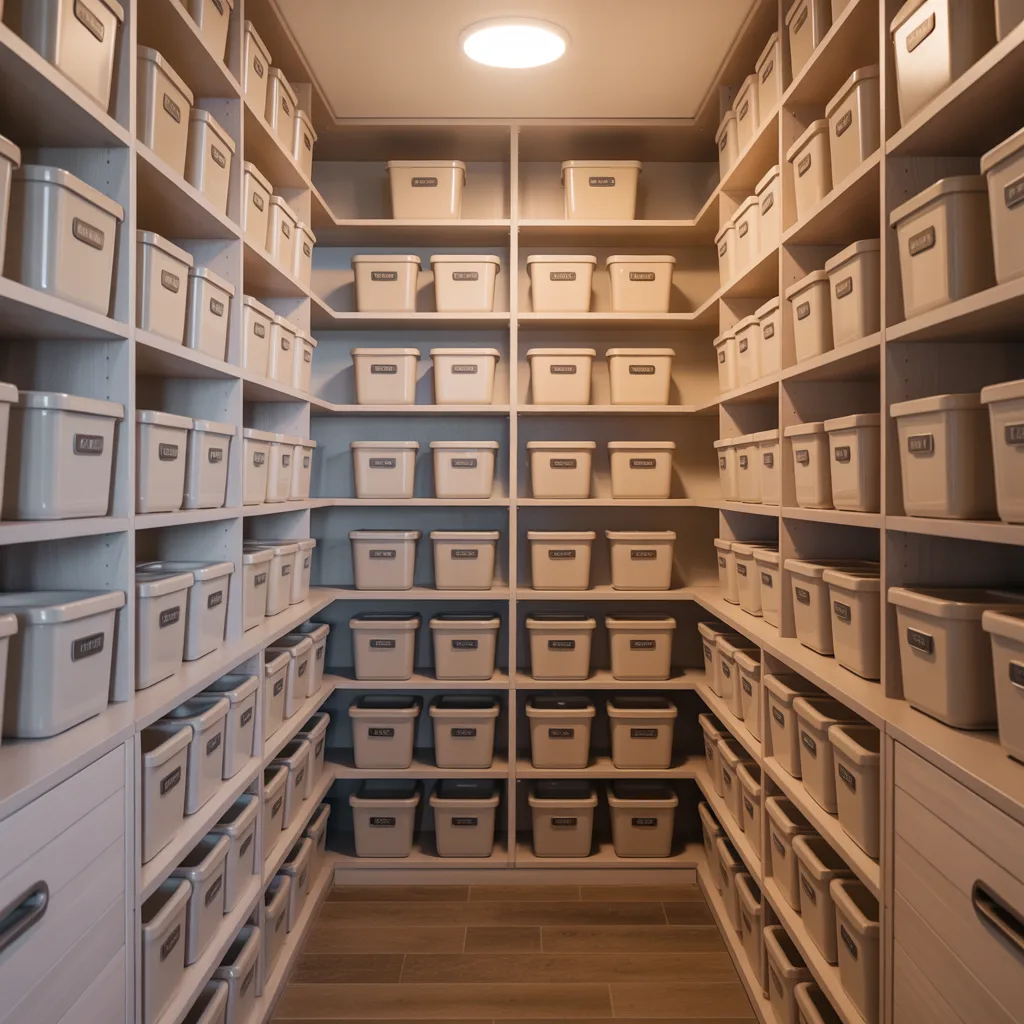
27 Pantry Organization Ideas That Make Meal Planning and Cooking Actually Easier
A disorganized pantry costs more than most people realize. Every duplicate item bought because you couldn’t see what was already there. Every expired product pushed to the back and forgotten. Every meal planning session that stalls because you can’t quickly assess what you actually have. These costs are small individually and enormous collectively — and they repeat every single week for as long as the pantry stays disorganized. Most people absorb them so routinely they’ve stopped noticing them.
Good pantry organization eliminates all of it. When every category has a zone, when containers are clear and labeled, when items are arranged by how often you use them, meal planning takes less time, grocery shopping gets more accurate, cooking flows faster, and food waste drops significantly. This list covers 27 pantry organization ideas that address every element of the problem — from the initial audit to the specific products and systems that keep a pantry working well over months and years.
Best Pantry Organization Ideas to Try in Your Home
The best pantry organization systems share one quality: they’re easier to maintain than to ignore. When categories have designated zones, items return to them automatically without requiring a deliberate decision. When containers are clear and labeled, anyone in the household can find and replace things correctly without asking. When the system is designed for the specific way this household actually shops and cooks, it stays organized naturally rather than requiring weekly resets to stay functional.
What follows covers the full range of pantry organization ideas — from the foundational first step of emptying and auditing to specific products, systems, and habits that keep a pantry genuinely organized over time. Some are free. Some require a modest investment. All of them are worth knowing if you want a pantry that works for the life you’re actually living rather than one that looks good in a photo and falls apart within a month.
Full Pantry Audit First Idea
The most important pantry organization step is the one nobody wants to do: empty the pantry completely before putting anything back. This isn’t optional. It’s the step that makes everything else possible. A full audit reveals what you actually have versus what you think you have, what’s expired and needs to go, what you have multiples of because the original was pushed to the back and invisible, and what categories exist in your pantry — which is the information you need to design a system that actually fits your household.
Block out about an hour for the initial audit. Remove everything, check expiry dates ruthlessly (anything expired goes), group the remaining items by category on a counter or floor, and then design the pantry system based on those actual categories rather than the categories you assume you have. Discovering that you own four cans of chickpeas and three bags of orzo because they were hidden at the back is exactly the kind of information that justifies the audit and that immediately saves money in the next grocery shop. Do this once, thoroughly, and everything that follows is significantly easier.
Zone Organization System Idea
Zone organization assigns a specific section of the pantry to a specific category of food and keeps that category exclusively in that section. Baking supplies always go on the same shelf. Canned goods always go in the same area. Snacks always occupy the same basket. When every item has a zone, restocking becomes automatic — you don’t have to decide where something goes, because it has a designated home. Finding things is instant. And the pantry stays organized because the system doesn’t require constant re-decisions.
Common pantry zones for most households: breakfast items (cereals, oats, granola bars), baking (flour, sugar, baking powder, chocolate chips), canned goods (beans, tomatoes, broths), dry goods (pasta, rice, lentils, quinoa), snacks (chips, crackers, nuts, dried fruit), oils and condiments, spices, drinks and beverages. Position zones by frequency of use: daily-use zones at eye level and arm’s reach, weekly-use zones above and below, rarely-used zones at the very top or bottom. This single organizational decision does more for pantry usability than any container or label system.
Clear Airtight Container System Idea
Transferring dry goods into clear airtight containers is the single most transformative pantry organization step available. It solves multiple problems simultaneously: contents stay fresh longer than in original packaging, quantities are visible at a glance without opening anything, the visual noise of mixed packaging disappears, and the pantry reads as an organized system rather than a collection of random products. The difference between a pantry with original packaging and one with uniform clear containers is immediately dramatic.
OXO Pop containers are the most widely recommended option — the lids seal positively with a one-touch release, they stack consistently, and the square format maximizes shelf space better than round containers. A starter set of 10 in the most useful sizes runs about $50-70 on Amazon or at Target. For a more affordable alternative, Vtopmart or similar brands on Amazon offer sets of 24+ containers for about $30-40 — the quality is lower but they look good on shelves and work well for most pantry applications. Buy all containers in the same brand and size family for the best result.
Consistent Labeling System Idea
Labels transform a pantry from a collection of containers into a readable, shareable system. Every container, every basket, every shelf section should be labeled with what belongs there — because what’s obvious to the person who organized the pantry is not obvious to everyone else who uses it. And when items have explicit labels, they’re significantly more likely to return to the correct location after use rather than landing wherever there’s space.
A Dymo label maker at $25-30 creates clean, consistent labels that read clearly from pantry distances. For a warmer look, round chalkboard labels from Amazon at $8-12 for a large set write beautifully with a chalk pen and look particularly good on glass jars and natural baskets. Apply labels to both the container lid and the container front — the lid label helps when containers are stacked, the front label helps when they’re on a shelf. Spend the hour it takes to label everything properly after the initial organization. The time investment pays back immediately in a system that stays organized without constant correction.
Turntable for Deep Shelves Idea
Deep pantry shelves create one of the most consistent organizational problems in any kitchen: items pushed to the back become invisible and inaccessible without removing everything in front of them. Turntables — lazy Susans — solve this by making the back of the shelf as accessible as the front with a single rotation. This simple addition turns a frustrating, hard-to-use shelf into one of the most functional storage surfaces in the pantry.
Turntables work best when used for a single category rather than mixed items — a turntable for oils and vinegars, a separate one for spices, a third for condiment bottles. Single-category turntables spin freely and retrieve any item in the category with one turn; mixed turntables require sorting through multiple categories to reach the item you want, which defeats the organizational purpose. Turntable sizes from Amazon range from $8-15 for a standard 12-inch option to $15-25 for larger double-tier versions. Measure your shelf depth before ordering to ensure the turntable fits without overhanging.
Pull-Out Basket System Idea
Pull-out wire baskets or sliding drawers installed on pantry shelves bring the back of any shelf to the front without reaching or removing front items. For lower shelves especially — where bending and reaching make deep storage genuinely awkward — a pull-out basket makes the full shelf depth accessible without effort. This is one of the most functional pantry organization additions available and is consistently among the most appreciated after installation, because it turns frustrating storage into effortless storage.
Wire pull-out baskets from Amazon or The Container Store run about $15-35 each depending on size and whether they have slides or just roll on the shelf surface. Sliding versions with metal drawer slides are more expensive at $25-50 each but work much better for heavy items. Use pull-out baskets for snacks, small canned goods, sauce packets, tea bags, and other categories with many small items that are difficult to retrieve from deep fixed shelves. Label the front of each basket with the category it holds so the system is navigable by everyone.
Tiered Riser for Canned Goods Idea
Canned goods stacked on a flat shelf create one of the most persistent pantry visibility problems: the cans at the back are completely hidden by the cans at the front. You can’t see or reach what’s there without moving everything in front of it. A tiered riser solves this completely — it’s a stepped shelf that lifts each row of cans higher than the one in front, making every can visible and accessible simultaneously. It’s one of those organization tools that seems obvious in retrospect and that people wonder how they organized without.
Bamboo tiered can risers from Amazon or Target run about $12-20 for a three-tier version that holds 20-30 standard cans. Organize the riser by category — all tomatoes together, all beans together, all broths together — with labels facing forward so every can’s contents are readable at a glance. This arrangement also makes inventory at a glance: you can see immediately when a category is running low without counting or shifting cans. A tiered riser is one of the most affordable and most impactful single-purchase pantry organization items available.
Door-Mounted Storage Idea
The back of a pantry door — or the inside of a pantry cabinet door — is one of the most consistently underused storage surfaces in the kitchen. A door-mounted organizer with shallow pockets or shelves adds significant storage capacity without touching the shelves. Items that need to be accessible without opening the full pantry — spices, small bottles, sauce packets, snack bars, wraps and foil — are perfectly suited to door-mounted storage where they’re immediately visible and immediately reachable.
Over-door wire organizers from Amazon or a hardware store run about $15-30 for a version with multiple adjustable shelves. For inside-the-door cabinet mounting, adhesive-backed organizers from Command or hook-and-pocket systems from The Container Store work without drilling. Measure the door clearance carefully before purchasing — pantry doors often open close to shelves, and an organizer that prevents the door from closing fully is worse than no organizer at all. Use the door for items you reach for every day, not for overflow storage.
Dedicated Baking Zone Idea
Baking requires more ingredients and tools than most other cooking activities — flour, sugar, brown sugar, baking powder, baking soda, salt, vanilla, cocoa, chips, measuring cups, measuring spoons. When these items are scattered across the pantry, every baking session begins with a hunt that takes longer than the actual mixing. A dedicated baking zone — one shelf or one section where every baking ingredient lives together — turns baking from a search-and-gather exercise into something you can start in under two minutes.
Clear containers for the dry goods — flour, sugar, brown sugar, oats, cocoa, breadcrumbs — plus a small basket for the smaller items (baking powder, baking soda, vanilla, salt, extracts) keeps the zone organized without requiring individual containers for every small item. Keep measuring cups and spoons in or immediately beside the baking zone so they’re at the baking location rather than in a kitchen drawer across the room. The physical proximity of tools and ingredients is what makes the baking zone genuinely faster rather than just better-looking.
Spice Organization System Idea
Spices are one of the most frequently searched categories in any pantry, and when they’re disorganized — placed wherever they fit, mixed sizes and brands, labels facing every direction — finding the right spice requires reading every label in the collection. This is a minor frustration that compounds. An alphabetical spice organization or a cuisine-based organization (Italian herbs together, Indian spices together, baking spices together) makes any spice findable in seconds without reading every label.
Decanting spices into uniform jars with printed labels creates the cleanest result — a set of 24 matching spice jars from Amazon or IKEA runs about $20-30. Alphabetical organization works for most households; cuisine-based organization works better for households that cook specific cuisines regularly. A tiered spice drawer insert from Amazon at $15-25 that holds 20+ spices in a deep drawer makes every label readable at once without moving anything. Pull-out spice racks that mount to the back of a cabinet door are another excellent option at $15-30, particularly for smaller collections.
FIFO Restocking Method Idea
FIFO — first in, first out — is the restocking method used in professional kitchens and grocery stores, and it’s the single most effective habit for eliminating pantry food waste. The principle is simple: new items go behind or beneath older items of the same category so older items are always used first. Without this habit, new items placed in front push older ones to the back where they’re forgotten and eventually expire — which is how most household pantry waste happens.
The FIFO habit requires about thirty seconds per restocking session: before putting a new can or box on the shelf, move the older ones forward and put the new one behind. For containers, transfer new dry goods into the back of the container and rotate older product to the front. Check expiry dates during every restocking session — items that will expire before they’ll realistically be used move to the front of the category for immediate use or get donated. This habit, maintained consistently, eliminates almost all pantry food waste and is the cheapest pantry organization improvement available.
Under-Shelf Basket System Idea
Under-shelf wire baskets clip onto the underside of an existing pantry shelf and hang below it, adding a row of storage in the space between shelves without any installation beyond clipping on. For pantries where adding new shelves isn’t possible, this is one of the most accessible ways to meaningfully increase storage capacity — it converts dead air space into organized storage using space that was previously contributing nothing.
Under-shelf wire baskets from Amazon or The Container Store run about $10-20 per basket for a version sized for standard shelf depths. They work best for items that are flat or that fit in the basket height available — foil and wrap boxes, small snack bags, sauce packets, tea bags, and similar thin or small items. Measure the gap between shelves before ordering to ensure the basket plus its contents fit within that gap with adequate clearance for retrieval. Use one category per basket, labeled, for the most organized result.
Breakfast Items at Eye Level Idea
Breakfast is the meal made most often under time pressure — weekday mornings when speed matters and deliberation doesn’t. A breakfast zone at eye level — cereals, oats, granola, protein bars, coffee, tea, and anything else used at breakfast — makes the most time-pressured meal of the day faster and less stressful. When everything needed for breakfast is in one place at easy-reach height, the morning routine flows without searching, without moving things to reach behind them, and without the low-level friction that makes mornings harder than they need to be.
Position the breakfast zone on the shelf most convenient for the person who makes breakfast most often — eye level for an adult, accessible height for a child who gets their own breakfast. A small basket within the breakfast zone for individual-serving items (oat packets, tea bags, coffee pods) keeps the zone from spreading across the full shelf. A simple label confirms to every household member where breakfast items live, which reduces the kitchen-pantry back-and-forth that most morning routines involve.
Snack Basket System Idea
A dedicated snack basket — a single clearly labeled container holding all household snacks — solves several pantry problems simultaneously. It prevents snacks from being scattered across multiple shelves. It makes the snack inventory visible at a glance so you know when restocking is needed. And it gives children a specific, sanctioned location for self-service snacking without opening and rummaging through every other section of the pantry. The contained snack zone is both an organizational tool and a subtle household management system.
A large woven basket or a wire bin from Target or Amazon in the $15-25 range works perfectly as a snack basket. Position it at a height that’s accessible to whoever uses it most. Restock it once weekly during grocery unpacking rather than adding individual items ad hoc — this creates a consistent visual standard for how full the basket should be and prevents the habit of over-buying snacks just because the basket looks empty. When the basket is empty, it’s time to shop, not time to dig through the pantry for hidden snacks.
Refrigerator Extension Organization Idea
Pantry organization doesn’t stop at the pantry door. Some pantry items migrate to the refrigerator — opened sauces, condiments, leftover grains, prepared ingredients. Applying the same organization principles to the refrigerator extends the pantry system into cold storage and prevents the refrigerator from becoming the chaotic counterpart to an otherwise organized pantry. Clear bins by category in the refrigerator, labeled and arranged by frequency of use, create a complete and consistent food storage system across both environments.
Clear rectangular bins in a consistent size from Amazon or The Container Store at $5-15 each fit most standard refrigerator shelves and hold items within a category without rolling or sliding. Label each bin with the category it holds — condiments, leftovers, produce prep, beverages — and apply the same FIFO rule in the refrigerator as in the pantry: older items in front, newer items behind. Refrigerator organization that mirrors the pantry system makes meal planning and cooking faster by making inventory visible and accessible in both storage environments simultaneously.
Pantry Lighting Upgrade Idea
A pantry without adequate lighting is a pantry where items at the back of shelves are invisible and where checking inventory requires guessing rather than seeing. Most pantries — especially walk-in pantries and deeper cabinet pantries — are significantly under-lit. Adding under-shelf LED lighting makes every shelf visible from front to back, makes inventory checking at a glance genuinely possible, and makes the whole pantry significantly more usable during both daytime and evening hours.
Battery-powered LED puck lights with motion sensors from Amazon run about $15-25 for a set of six and install with peel-and-stick backing under each shelf. They activate automatically when you open the pantry door and turn off after a few minutes of no movement. LED strip lights hardwired to a switch cost more to install but provide brighter, more consistent illumination. Warm white LED strips at 2700-3000K produce a more pleasant working light than the cool white that most basic LED options default to. The difference in pantry usability between poor lighting and good lighting is significant enough that lighting is often the highest-return single upgrade available for a pantry with functional shelving already in place.
Pantry Inventory List System Idea
A running pantry inventory — a physical or digital list of what’s in the pantry and approximately how much — is one of the most consistently high-return pantry habits available. It makes meal planning faster because you’re working from accurate information rather than opening the pantry and trying to remember. It makes grocery shopping more accurate because you know what you actually need rather than estimating. And it prevents the duplicate purchasing that happens when an item is pushed to the back and assumed to be absent.
The simplest version is a small whiteboard on or near the pantry with a running list of items that need restocking. The slightly more organized version is a shared note in Apple Notes or Google Keep that’s accessible during grocery shopping. Either way, the habit is: when something hits the halfway mark, it goes on the list; when it’s empty, it’s a priority. Clear containers make this habit easier because you can see quantity at a glance. This system costs essentially nothing to implement and saves real money in eliminated duplicates and expired items over months of consistent use.
Quarterly Pantry Purge Habit Idea
The best pantry organization system degrades over time without periodic maintenance. Items drift from their zones. New products get added without thought for where they belong. Expiry dates pass unnoticed. The quarterly pantry purge — removing everything from one category at a time, checking expiry dates, discarding what’s past date, donating items that won’t realistically be used, and returning everything to its correct zone — keeps the system functional and prevents the back-of-shelf accumulation that undermines every other organizational effort.
Quarterly aligns naturally with the seasons, which makes it easy to remember: at the start of each new season, do the audit. It takes about an hour total when done category by category rather than all at once. During each quarterly purge, also check whether the organization system is still working — whether the zones still make sense, whether the container sizes still match what you’re buying, whether any category has grown beyond its current allocation. A system that’s periodically reviewed and adjusted stays more useful than one that was organized once and never revisited.
Measurement Before Buying Idea
The most common pantry organization mistake is purchasing containers, baskets, turntables, and pull-out systems without measuring the pantry shelves first. Containers too deep for the shelf can’t be pulled out easily. Baskets too wide don’t fit side by side. Turntables larger than the shelf depth extend past the edge. Every pantry organization product should be measured against the specific shelf dimensions before purchase — because a container that doesn’t fit properly causes more organizational dysfunction than no container at all.
Measure pantry shelf depth, shelf width (total width and the usable width between uprights or walls), and shelf height (the gap between adjacent shelves) before purchasing any organizational product. Keep a running note on your phone with these measurements so you can reference them while shopping online or in-store without going back to measure again. This twenty-minute measurement session at the start of any pantry organization project prevents most of the fitting problems that turn a planned organization project into an expensive return trip and a second purchase attempt.
Household-Wide System Adoption Idea
A pantry organized by one person for one person’s use is functional for that person and confusing for everyone else. The most organized pantry in the world fails if household members don’t understand the system, can’t find what they’re looking for, and put things back in the wrong place because the system wasn’t communicated. The final and most overlooked pantry organization step is making the system legible and usable for every member of the household who accesses it.
A brief walkthrough of the pantry organization system — where each zone is, what the labeling convention means, what goes where when restocking — takes about five minutes and is significantly more effective at maintaining organization than any amount of additional labeling or signage. Involve household members in the organization process where possible, especially children who are old enough to stock their own snacks or help with grocery unpacking. People maintain systems they participated in creating far more consistently than systems imposed on them, regardless of how well-designed those systems are.
FAQs About Pantry Organization Ideas
What pantry organization ideas make the biggest difference immediately?
The full audit, clear airtight containers for dry goods, and a zone organization system are the three changes that have the most immediate and sustained impact on pantry usability. The audit reveals the actual contents and informs every subsequent decision. Clear containers eliminate visual noise and make quantities visible. Zone organization means items have designated homes and the system is maintainable without constant re-decisions. Together these three steps transform a pantry from chaotic to functional in one focused session.
What containers are best for pantry organization?
OXO Pop containers are the most widely recommended for dry goods — reliable airtight seals, consistent sizing that stacks well, and available in a complete range from cereal-box size to small spice jar. For baskets and bins, natural seagrass looks best on open shelves; clear acrylic or wire baskets work better where visibility into the container is important. Buy all containers from the same brand and in a consistent size family — the visual cohesion of matched containers does more for the pantry’s organized appearance than any other single factor.
How do I organize a small pantry or cabinet?
Maximize vertical space with shelf risers and under-shelf baskets. Use turntables on every deep shelf to make the back accessible. Mount an organizer on the back of the door for small and frequently-used items. Use pull-out baskets on lower shelves. Decant all dry goods into uniform containers to eliminate packaging bulk. Apply the FIFO rule consistently so nothing gets buried. A small pantry organized correctly outperforms a large pantry organized by accident — the constraint forces better decisions about what actually belongs in the space.
How do I stop my pantry from becoming disorganized again?
The pantry stays organized when the system is easier to follow than to ignore. That means every category has a designated zone so items have an obvious home. Containers are labeled so anyone can put things back correctly. Restocking follows the FIFO rule automatically. And a quarterly audit catches drift before it becomes disorder. The simplicity of the system matters more than its comprehensiveness — a simple system that everyone follows beats a complex system that only the organizer understands.
How much does pantry organization cost?
A basic pantry organization using turntables, tiered can risers, under-shelf baskets, and a label maker typically runs $80-150 depending on pantry size. Adding a full set of clear airtight containers for dry goods adds another $50-100. A complete walk-in pantry organization with uniform baskets, pull-out drawers, and full container system can reach $300-500. The return in reduced food waste, faster cooking, and eliminated duplicate purchases typically recoups the cost within three to six months of consistent use.
Conclusion of Pantry Organization Ideas
A well-organized pantry makes every meal slightly faster to prepare, every grocery shop more accurate, every household budget slightly more efficient, and every week in the kitchen slightly less frustrating. These are not dramatic improvements — they’re the small, cumulative gains that add up to a meaningfully better experience of cooking and household management over months and years. And they’re achieved through organizational decisions that, once made and maintained, require almost no ongoing effort.
Start this weekend. Empty the pantry. Audit what’s there. Assign zones. Label what you have. Order the containers that will make the system work. The pantry that results from that work will make every subsequent day in the kitchen measurably easier than the one before it. And that’s exactly what a good pantry organization system is supposed to do — not look impressive in a photo, but quietly make the daily work of feeding a household easier, week after week, without asking much in return.